
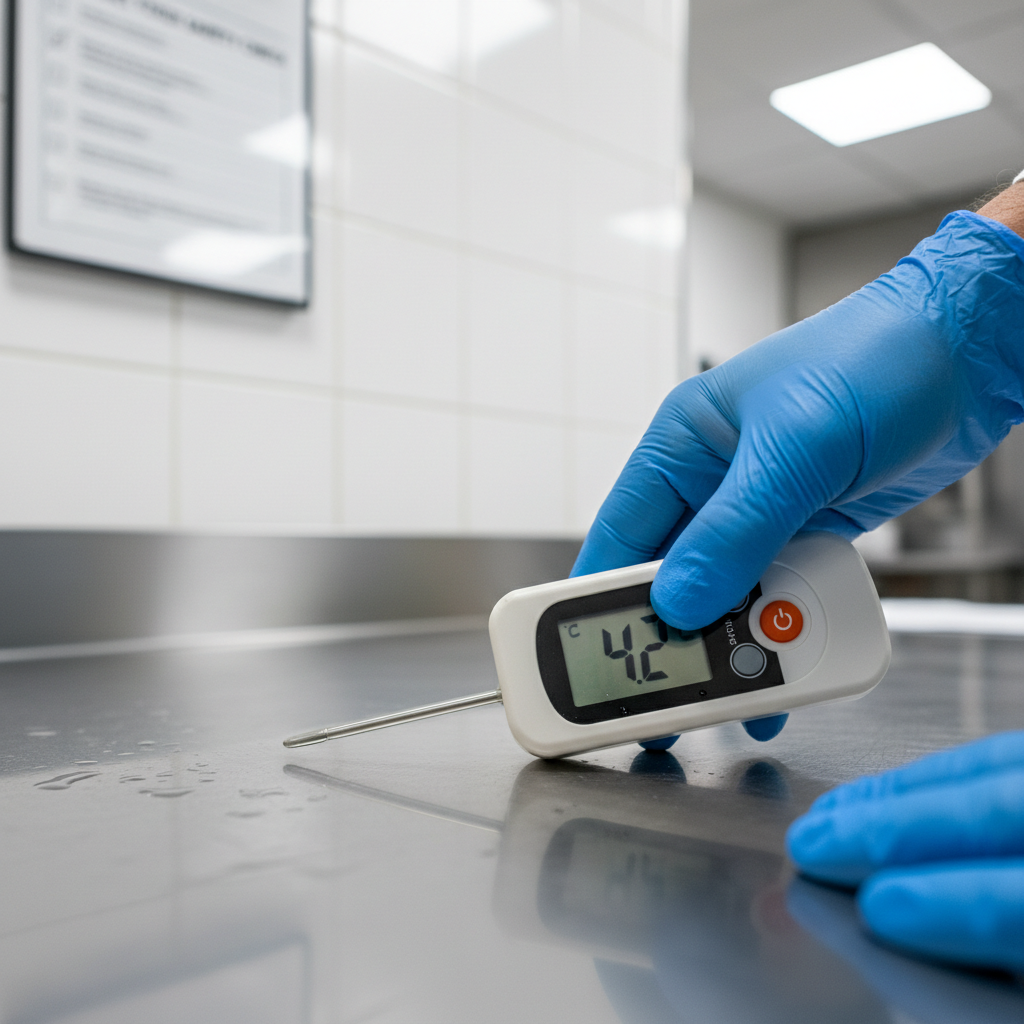
What Riverside County Inspectors Found in 2025
Across 4,218 inspected facilities, these five categories drove 83% of all re-inspection orders. Each number below is a facility — not a statistic.
⚠ Data reflects Riverside County Health Department inspection records, January–December 2025.
Percentages reflect proportion of inspected facilities receiving at least one violation in this category. A single facility may appear in multiple categories.
Temperature Abuse
2,863 facilities affected
Most common critical violation. Foods held outside 41°F–135°F range for more than 4 hours. Causes immediate closure in 1 of every 3 findings.
Improper Handwashing
2,278 facilities affected
Inspectors check sink access, soap dispensers, and paper towel supply. A single blocked handwashing station can trigger a critical violation.
Cross-Contamination
1,982 facilities affected
Raw proteins stored above ready-to-eat foods, shared cutting surfaces, and improper glove use account for nearly half of all re-inspections.
Pest Evidence
1,307 facilities affected
Rodent droppings or live insects result in automatic critical violation and same-day closure. Gap sealing and contractor logs are your first defense.
Labeling & Date Marking
1,223 facilities affected
Ready-to-eat foods prepared on-site must be date-marked with a 7-day discard date. Missing labels are a frequent minor violation that add up fast.
What Happens During an Inspection
Understanding the inspector's sequence removes the anxiety. Here is the exact order of events, with typical time allocations for a standard food service facility.
Unannounced Arrival
Inspectors arrive without prior notice during operating hours. They will identify themselves, present credentials, and request access to all food preparation and storage areas.
Facility Walkthrough
A systematic walk through the kitchen, storage areas, restrooms, and service areas. Inspectors check temperatures with calibrated thermometers, observe employee practices, and examine equipment.
Documentation Review
Temperature logs, employee food handler certifications, pest control service records, and equipment calibration records are reviewed. Missing documentation is itself a violation.
Violation Assessment
Each finding is classified as Critical, Serious, or Minor. Critical violations (imminent health hazard) may trigger immediate closure. The inspector tallies the score.
Exit Interview
The inspector reviews all findings with the operator, explains each violation, and sets correction deadlines. Operators may correct minor violations on-site during this time.
Report & Posting
The official inspection report is issued and must be posted in a visible public location. The grade placard (A/B/C) goes in the front window. Results are public record.
How Your Score Is Calculated
Every facility starts at 100 points. Violations deduct points based on severity. The final score determines your posted grade. Here is exactly how points leave the board.
90–100
Passing
Facility meets all critical requirements. Minor violations may exist but do not pose an immediate public health risk.
80–89
Conditional
Serious violations present. A re-inspection is scheduled within 30 days. Grade B must be posted prominently.
70–79
Re-inspect Required
Multiple serious violations. Mandatory re-inspection within 14 days. Failure to correct may result in permit suspension.
Below 70
Immediate Closure
Critical violations posing imminent health hazard. Facility closed until all critical items are corrected and re-inspection passes.
Common Point Deductions
| Violation | Type | Points Lost |
|---|---|---|
| Food held at unsafe temperature (>4 hrs) | Critical | –5 to –25 |
| No handwashing soap or paper towels | Critical | –5 |
| Evidence of pest activity | Critical | –5 to –25 |
| Employee with illness symptoms handling food | Critical | –5 |
| Improper chemical storage near food | Serious | –3 |
| Missing date labels on ready-to-eat food | Serious | –3 |
| Sanitizer concentration out of range | Serious | –2 |
| Missing food handler certifications | Minor | –1 |
| Equipment not cleaned per schedule | Minor | –1 |
Free Resource
Download the Pre-Inspection Checklist
A 47-point checklist organized by inspection order — temperature logs, station readiness, documentation, and employee compliance. Used by 2,400+ Riverside County operators.
The Three Tiers of Violations
Not all violations are equal. Understanding the tier system tells you exactly which findings will close your doors today versus which ones give you a month to correct.
Critical Violations
Violations that directly contribute to the risk of foodborne illness. These represent an imminent or active public health hazard. Inspectors may order immediate closure.
Common Examples
Food held at unsafe temperatures (41°F–135°F danger zone)
Employee with vomiting/diarrhea handling food
No running hot water at handwashing sink
Evidence of rodent or insect activity in food areas
Toxic chemicals stored with food or food equipment
Consequence
Closure order issued same day. Re-inspection required before reopening.
Correction Window
Immediate or same-day
Serious Violations
Violations that could contribute to foodborne illness under certain conditions. Not an immediate hazard but require correction within a set timeframe.
Common Examples
Date labels missing on ready-to-eat foods
Sanitizer concentration outside required range
Handwashing sink used for food prep or storage
No consumer advisory for raw/undercooked proteins
Food contact surfaces not sanitized between uses
Consequence
Re-inspection scheduled within 30 days. Points deducted (–2 to –3 each).
Correction Window
14–30 days
Minor Violations
Violations that do not directly relate to foodborne illness risk but indicate general non-compliance. These are tracked and patterns can escalate to serious classification.
Common Examples
Missing food handler certification cards on file
Equipment not cleaned on documented schedule
Thermometers not calibrated within required period
Single-use items reused (gloves, containers)
Facility maintenance issues (lighting, pest exclusion gaps)
Consequence
Noted in report. Pattern of minor violations may prompt increased inspection frequency.
Correction Window
30–90 days
How to Prepare Your Facility
These are the exact areas an inspector walks through, in order of priority. Address them the same way — critical risks first, documentation last.
✓ Facilities that self-audit 48 hours before an inspection score 12 points higher on average.
Source: Riverside County Health Department annual compliance report, 2025.
Temperature Control
Calibrate probe thermometers — verify accuracy in ice water (32°F) and boiling water (212°F)
Audit walk-in cooler and freezer temperatures; log results for 48 hours prior to inspection
Check hot-hold equipment: steam tables, heat lamps, warming drawers all above 135°F
Ensure rapid-chill equipment (blast chiller) is operational and documented
Handwashing Stations
All designated handwashing sinks must be clear and accessible — no storage in or around them
Soap dispensers filled and functional at every sink
Single-use paper towels or approved hand dryer at each station
Hot water must reach 100°F at handwashing sinks within 30 seconds
Documentation
Current food handler certifications for all active staff — printed copies on site
Temperature logs for last 30 days, organized by station
Pest control service records showing visits within the last 90 days
Equipment cleaning schedule with completion signatures
Allergen training documentation for front-of-house staff
Food Storage & Labeling
All ready-to-eat foods date-labeled with preparation date and 7-day discard date
Raw proteins stored below and separate from ready-to-eat foods in all coolers
FIFO (First In, First Out) rotation visible in dry storage and walk-ins
No food stored directly on the floor — minimum 6-inch clearance
Sanitation & Equipment
Sanitizer solution at correct concentration (chlorine: 50–200 ppm; quat: 200–400 ppm)
Sanitizer test strips available and accessible for inspector verification
All food contact surfaces clean and sanitized within last 4 hours
Wiping cloths stored in sanitizer solution between uses
Permit Requirements by Facility Type
Select your facility type below. Fees reflect Riverside County 2025 schedule. Requirements and costs vary — confirm with your local environmental health office before applying.
Full-Service Restaurant
Typical timeline: 6–12 weeks from application
| Required Permit / Document | Est. Fee | Notes |
|---|---|---|
| Food Facility Permit (annual) | $425–$850 | Based on seating capacity |
| Food Handler Cards (all food workers) | $15/person | Valid 3 years, state-approved course |
| Certified Food Manager (1 per facility) | $85–$120 | SERVSAFE or equivalent exam |
| Business License | $75–$200 | City/county dependent |
| Fire Safety Permit | $150–$300 | Hood suppression system inspection |
Note: Fees shown are 2025 Riverside County schedule. Some cities within the county (Riverside, Palm Springs, Temecula) may charge additional municipal fees. Always confirm with your local Environmental Health office.
Look Up Your Last Inspection Record
All inspection reports in Riverside County are public record. Search by facility name, address, or permit number to see your full inspection history, violation details, and re-inspection dates.
Open Public Records Database